STS 2026 : The 4th Semi-supervised Teeth Segmentation Challenge on Metal Artifact Reduction and Beyond
MICCAI 2026, Strasbourg, France
September 27-October 1, 2026
Introduction
Digital dentistry increasingly relies on cone-beam computed tomography (CBCT) and intraoral scans (IOS) for diagnosis, treatment planning and image-guided intervention. CBCT provides root, bone and anatomical context, while IOS captures high-resolution crown geometry. In patients with fillings, crowns, bridges or implants, however, metal artifacts introduce streaking, shadowing and blooming effects that obscure boundaries and reduce the reliability of automated dental analysis.
STS 2026 focuses on artifact-resilient dental AI under real-world conditions. Unlike earlier editions centered on cleaner segmentation data, this challenge uses a multi-center dataset in which every case contains metallic objects. Participants are asked to build semi-supervised pipelines that remain robust when metal artifacts affect both anatomical segmentation and cross-modal IOS-CBCT alignment.
The challenge is organized around three tasks. Task 1 focuses on CBCT teeth segmentation in scans affected by metal artifacts. Task 2 evaluates CBCT-IOS registration for cross-modal dental model fusion. Task 3 is based on the MMDental dataset, extending the challenge toward multimodal dental AI that connects tooth CBCT images with expert medical records.
Dataset Access
Please register on Codabench and join the corresponding task. The training and validation data can be downloaded directly from the platform after access is granted.
- GitHub Resources: https://github.com/ricoleehduu/sts-skill
Pre-Task: 2D Images Segmentation Qualification
Before applying for the official STS 2026 dataset, teams should first complete the Codabench pre-task on 2D image segmentation. This qualification screen is used to verify basic segmentation capability and submission readiness. Only teams that pass the pre-task can apply for challenge data access.
Task 1: Metal Artifact CBCT Teeth Segmentation
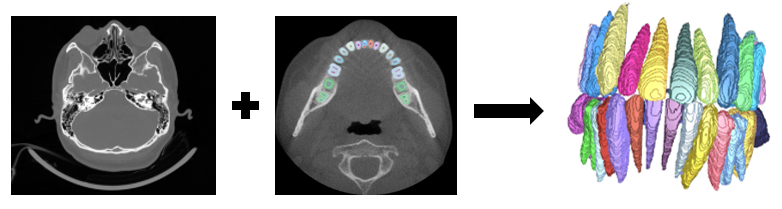
Segment teeth from CBCT scans containing metal artifacts caused by restorations, crowns or implants, with emphasis on robust tooth boundary recovery under streaking and blooming interference.
Task 2: CBCT-IOS Registration
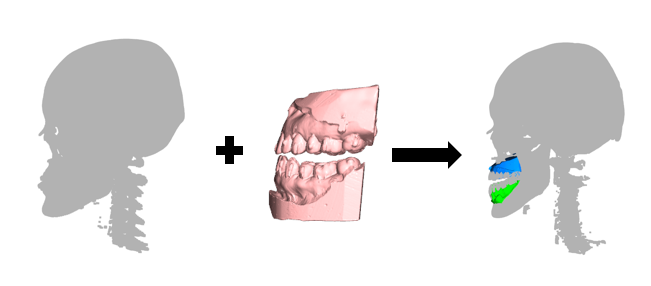
Align intraoral scan crown surfaces with CBCT volumes, combining high-resolution IOS geometry with CBCT root and bone information for complete digital patient models.
Task 3: MMDental Multimodal Analysis
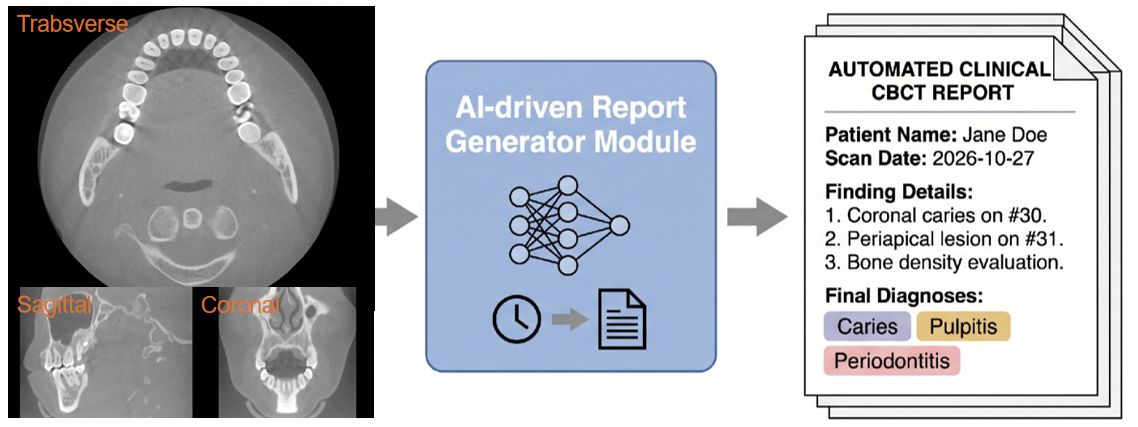
Use tooth CBCT images together with expert medical records, initial diagnoses and follow-up documentation to support multimodal dental diagnosis and clinical reasoning.
Updates
The 2026 edition introduces a metal-artifact-centered benchmark for real-world dental AI. The website now follows the updated three-task structure: metal artifact CBCT teeth segmentation, CBCT-IOS registration and MMDental multimodal analysis.
- [2026.03.10] The STS 2026 challenge proposal was finalized.
- [2026.05.11] Registration opens, and the training and validation data are released.
- [2026.07.15] Docker submission portal opens for the final test set.
- [2026.08.01] Final submission deadline.
- [2026.08.15] Results are announced.
- [2026.09.27-10.01] STS 2026 will take place with MICCAI 2026 in Strasbourg, France.
Important Dates
| Registration Opens / Training and Validation Data Release | May 11, 2026 |
| Docker Submission Portal Opens | July 15, 2026 |
| Final Submission Deadline | August 1, 2026 |
| Results Announcement | August 15, 2026 |
| MICCAI 2026 | September 27-October 1, 2026 |
Contact
For questions about STS 2026, please contact SemiTeethSegChallenge@outlook.com or zhi.li@hdu.edu.cn. We welcome questions, feedback and collaboration requests related to the STS 2026 challenge and look forward to meeting the community in Strasbourg.
Related References
- [1] Yaqi Wang et al. "MICCAI 2023 STS Challenge: A retrospective study of semi-supervised approaches for teeth segmentation." Pattern Recognition, 170, 112049, 2026.
- [2] Yaqi Wang et al. "MICCAI STSR 2025 Challenge: Semi-Supervised Teeth and Pulp Segmentation and CBCT-IOS Registration." arXiv, arXiv:2512.02867, 2025. Available at https://arxiv.org/abs/2512.02867.
- [3] Yaqi Wang et al. "MICCAI STS 2024 Challenge: Semi-Supervised Instance-Level Tooth Segmentation in Panoramic X-ray and CBCT Images." Medical Image Analysis, 2026, 103986. Available at https://doi.org/10.1016/j.media.2026.103986.
Sponsors